I Took Owlet Sock Off From Baby and the Alarms Did Not Go Off
My twins spent a little over 100 days in the NICU after they were born. One of the many things I became accustomed to when I visited was flicking my optics to their monitors whenever the noises changed tone or frequency. "Beep beep booooonk" was someone's pulse ox dipping below 90 percent. A frantic "beepbeepbeep" meant tachycardia or bradycardia. And an oddly melodic "beeeeep beep beeeeep beep" meant the humidifier tubes that led to their isolettes weren't condensing correctly.
Nosotros definitely needed a product to continue that monitoring once we got home, and Owlet is one of the few companies that provides a wearable version for babies. Almost other companies that offer infant monitoring, like Nanit and Pamper's Lumi, brand cameras that include some kind of a vesture device. Based on its features and the recommendations from my NICU parents group, I started using the second-generation Owlet sock before this year when the twins were released from the NICU. I've been happy with it overall; I really like beingness able to check on my babies without having to walk upstairs and I rely on it to provide peace of listen when say, my kids insist on rolling onto their bellies in their sleep. Information technology's get an indispensable tool to have on both mine and my partner's phones.
Pros
- Wireless charging
- Piece of work through motion provides faster readings
- Sensor easier to modify
Cons
- Disconnection alerts are a hurting
- The sock fit isn't every bit expert every bit on the previous version

Owlet
Hardware
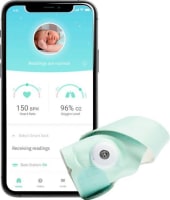
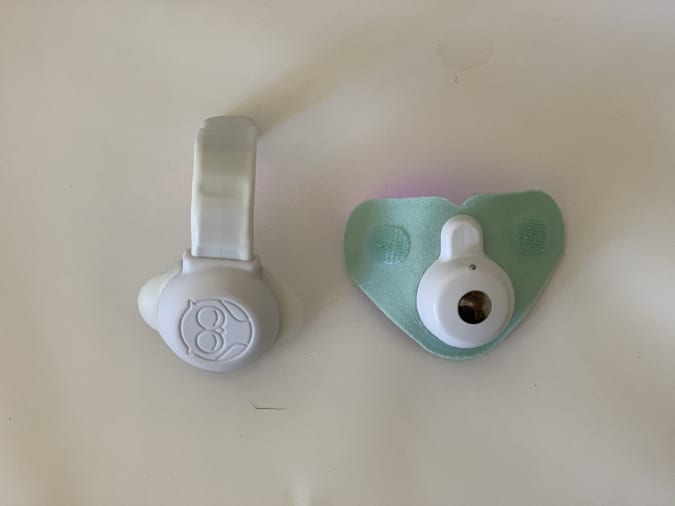
The third-gen Owlet sock is much like its predecessors: A sensor shines low-cal through the peel and, using the light that shines dorsum, it and so estimates the baby'southward blood flow and oxygen level. The Owlet sensor fits within a fabric "sock" that pairs to a WiFi connected base of operations station, and the base of operations station updates an app on your phone with readings. The wearable monitor uses a handful of color-coded alerts to update parents on their babies. Green ways reading information; blueish is low battery; white is charging; and orange is disconnected. Red means a dip in eye charge per unit or pulse ox, which triggers an insistent alarm as well to conspicuously signify potential distress. The new Owlet model features a redesigned fabric sock, a smaller base of operations station and wireless charging. These hardware upgrades are, for the most part, thoughtful and useful, with the exception of a few snags.
Amber Bouman/Engadget
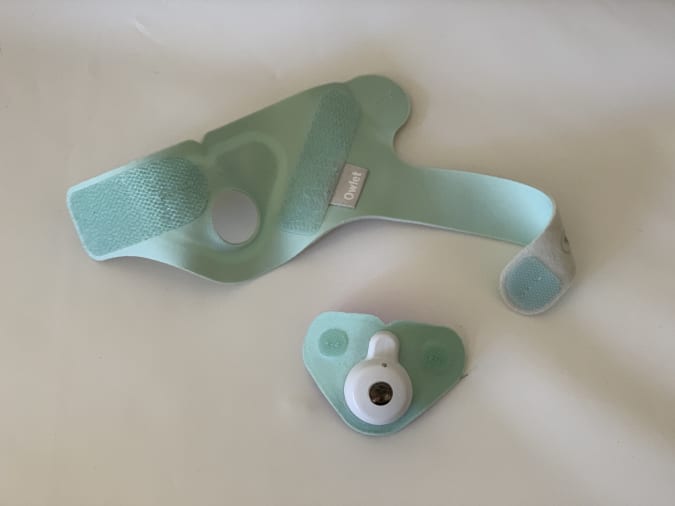
Allow'due south start with the sensor (one of the thoughtful bits). What had been a flat circular shape with a micro-USB dongle for charging is now a thicker, dongle-less, push button which sits in a butterfly-shaped fabric base. The sensor is secured into place by plumbing fixtures it through a hole in the sock, and then anchored using velcro. This makes it much easier to switch the sensor in and out of the 4 included socks. Of the two left-and-correct pairs, ane for children nether 12 pounds and 1 for those over 12 pounds. (This is too an update from the second-gen, which included 3 sizes of one sock which could piece of work on either foot.)
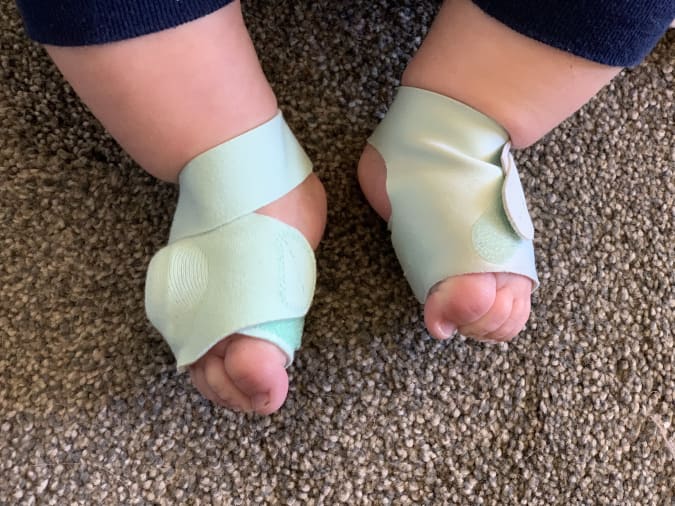
The sock is wrapped around the brawl of the foot and secured behind the talocrural joint with velcro straps like a tiny sports band. The sensor is located more on the side of the foot now, with the velcro underneath the foot. Owlet says many of these changes come from feedback from parents, but I constitute them problematic in practice. It is comically difficult to get the sock properly secured on a wriggling infant, but I generally managed okay with the second-gen model.
Amber Bouman/Engadget
With the changes to the third-gen sock, I not just found information technology harder to properly align the sensor, but it was also besides easy for my kids to slip the socks off. This had occurred randomly once or twice with the previous version, but with the new ane information technology happened five times between the twins in a matter of a week. The fashion the sensor and velcro are located makes them easy to snag and rub. I also found information technology harder to become the sock set smoothly on the pes which in plow made it more hard to properly secure both the ankle strap and the sensor. I referenced the Owlet transmission and instructions for tips on how to practise this amend, merely the ankle strap kept slipping off my son and the whole sock slipped off my daughter multiple times.
Because I couldn't quite get the socks to lie flat, it was harder to effigy out how to right the fit when I got an orange "difficulty getting reading" alarm. These orange 'disconnected' alerts are absolutely my to the lowest degree favorite part of the Owlet organization. When a sock alerts, it rings both your phone and the base station with notifications (and by playing "Hush little infant" with a flashing orange lite).
Amber Bouman/Engadget
I got a some scary red alerts with the latest socks, which are as every bit alarming every bit they should be. However, during the "Low oxygen/low heart rate" red alerts my babies looked totally fine. I checked the guides in Owlet's app which told me that, amongst other things, a disconnected sock could result in a partial reading, hence a red alert. This made the iffy fit on the socks all the more problematic (I did not enjoy leaping out of bed in the middle of the nighttime for a red alert that was due to a misalligned sock). In that location are several other factors (elevation, circulation, periodic breathing) that could contribute to red alerts, and Owlet provides a guide on what to practice if yous receive one. I wound upwardly talking to our pediatrician, who confirmed that I'd likely be able to easily identify a real emergency result versus an error alert.
All told, I saw many more orange disconnection alerts. They occurred when my kids slipped out of their socks, merely likewise sometimes for unknown reasons. This was especially unwelcome in the middle of the night, when I didn't want to risk waking sleeping babies with alert noises or sock readjustments. The second-gen sock at to the lowest degree had a way to minimize the sounds for these notifications, simply this selection is missing in the new version. This is the primary challenge with the Owlet system: A baby tin shift the sock plenty to trigger an alert. Yep, information technology's of import to know when the sensor isn't correctly seated, but I wish information technology didn't happen and so oftentimes. I also wish I meliorate understood what activities and behavior acquired the alerts when the sock seemed correctly fitted.
Amber Bouman/Engadget
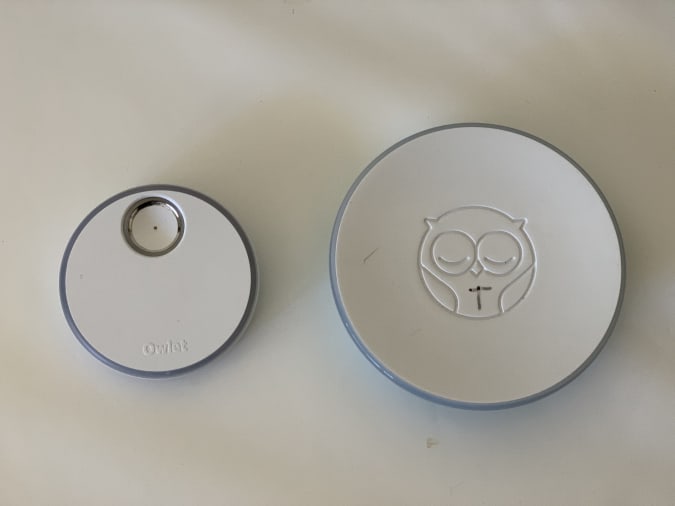
I appreciated the other hardware changes a lot more. The new base station is almost half the size of the one-time base station, which makes information technology easier to fit on a nightstand. It's significantly less bright than its predecessor, which makes it a lot less obtrusive in the heart of the nighttime (something that really aggravated my colleague Daniel Cooper in his original hands-on).
Upgrading the socks to wireless charging feels like a genius motion. This makes the device easier to put in a variety of places, with one less cable to keep rails of. Owlet says the redesigned sock tin grab an 8-hour charge in 20 minutes, and a full accuse in an hour and a half. Unlike the 2nd-gen model, the battery life here is measured in hours instead of a percentage, which was helpful but I seemed to get low battery warnings a lot earlier. Four hours of battery left doesn't seem worthy of an alert, if you ask me.

Amber Bouman/Engadget
A few other notes: It was overnice to see that the new socks automatically plow on the base station once your kid is wearing the sock; the old ones required you to manually turn on the station with a tap. If the socks go pushed off the base station while charging, it will trigger an orange disconnection alarm. Though Owlet only connects to two.4GHz WiFi, information technology will stay connected in the issue of a WiFi disruption. While staying in a hotel during a recent wildfire evacuation, I had no luck trying to connect the second-gen socks, but they immediately reconnected to my home WiFi when we returned.
Software
As with the hardware, the software changes here feel well idea-out. Owlet replaced its physical manual with an app download, and the GIFs and videos included in the app were actually pretty helpful. Installation was straightforward for both versions, though at that place was e'er a step I had to effort more than once. With the old version it was getting the WiFi connected; with the newer one it was registering a new device and assigning it to a kid.
For some reason the app had me add together the sock, then assign it — but I had to create a new profile instead of the one that I had created for the second-gen setup. So I had to re-register the same device once more nether the child's profile. None of this was particularly onerous, merely it seemed unintuitive to register each gadget twice. And, while information technology'southward nice that the app has an like shooting fish in a barrel mode to add multiple children and monitors, I at present take 4 entries in the app: one for each child and each device. That'due south a little cluttered, and I wish I was immune to rearrange the cards or tiles here. However, I did appreciate how the app on my partner'southward phone automatically updated after I added the new socks.

Owlet
Once installation is consummate, all the information is available by tapping that child's name/picture from the habitation screen. Your child'south information will refresh as updates are received from the sock. When your child moves information technology volition prove anxiety and say "wiggling," though the updated sock now features "work through motility," assuasive the sensor to go on taking readings "during activity such as diaper changes, burping or nose cleanouts." The previous sock would break readings during these movements. You can also toggle the base of operations station on or off from hither, something I've found useful when trying to turn off those orange 'disconnected' alerts I mentioned earlier.
Owlet includes the child's proper name on alert notifications in the app so you tin can tell whose sock needs your attention when an alert pops up. Only there's no such information in the notifications that announced on the app lock screen, and then you lot take to open the app to notice out which kid's sock is setting off the alarm. Because I'm on a satellite internet connexion, that increases the time to observe out what'due south going on during carmine alerts. The app also measures sleep trends, which was informative to accept on hand as I try to motility the twins into cribs. Another prissy touch: The information most babies on the 'Guide' page took prematurity into account and there's also a corresponding NICU-stay selection in the profile setup.

Bister Bouman/Engadget
Wrap-up
Despite my irritation with the orange alerts in general, I really like my Owlet socks. They provide me with helpful information and peace of mind, which counts for a lot. I too generally capeesh the changes that have been made to the third-gen device, with the new sock pattern beingness an of import outlier. The wireless charging, 'work through movement', sensor redesign and app changes are all features that make the organisation give faster and more accurate readings in the twenty-four hours-to-day. If you're able to tolerate the disconnection alerts, and have the patience to strap a sensor onto a baby, the Owlet is a solid organisation to accept for NICU, new or nerd parents akin.
Correction: Update 12/07/20: This review originally stated the second-generation Owlet sock could only be worn on 1 foot. The second-generation sock can exist worn on either foot. We accept updated the review appropriately.
All products recommended by Engadget are selected by our editorial team, contained of our parent company. Some of our stories include affiliate links. If y'all buy something through one of these links, we may earn an affiliate committee.
Source: https://www.engadget.com/owlet-smart-sock-third-gen-review-174414843.html
0 Response to "I Took Owlet Sock Off From Baby and the Alarms Did Not Go Off"
Post a Comment