Leroi Jones Was Not a Significant Writer of the Black Arts Era True or False
 Nikki Giovanni, a participant in the Blackness Arts Movement | |
| Years active | 1965–1975 (approx.)[one] |
|---|---|
| Country | Us |
| Major figures |
|
The Black Arts Movement (BAM) was an African American-led art movement, active during the 1960s and 1970s.[iii] Through activism and fine art, BAM created new cultural institutions and conveyed a bulletin of blackness pride.[4]
Famously referred to by Larry Neal equally the "aesthetic and spiritual sister of Black Power,"[v] BAM applied these aforementioned political ideas to art and literature.[6] The movement resisted traditional Western influences and institute new ways to nowadays the black experience.
The poet and playwright Amiri Baraka is widely recognized as the founder of BAM.[vii] In 1965, he established the Black Arts Repertory Theatre Schoolhouse (BART/S) in Harlem.[8] Baraka's example inspired many others to create organizations beyond the United States.[4] While these organizations were short-lived, their work has had a lasting influence.
Groundwork [edit]
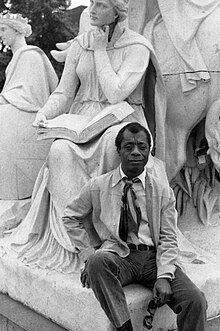
African Americans had ever made valuable creative contributions to American culture. However, due to brutalities of slavery and the systemic racism of Jim Crow, these contributions oftentimes went unrecognised.[9] Despite continued oppression, African-American artists continued to create literature and art that would reflect their experiences. A high-point for these artists was the Harlem Renaissance—a literary era that spotlighted blackness people.[10]
Harlem Renaissance [edit]
There are many parallels that can be fabricated between the Harlem Renaissance and the Black Arts Movement. The link is so potent, in fact, that some scholars refer to the Black Arts Movement era as the 2d Renaissance.[11] One sees this connection clearly when reading Langston Hughes's The Negro Creative person and the Racial Mountain (1926). Hughes's seminal essay advocates that black writers resist external attempts to control their art, arguing instead that the "truly smashing" black artist will be the 1 who can fully embrace and freely express his blackness.[11]
Still, the Harlem Renaissance lacked many of the radical political stances that defined BAM.[12] Inevitably, the Renaissance, and many of its ideas, failed to survive the Neat Depression.[13]
Civil Rights Move [edit]
During the Civil Rights era, activists paid more than and more attention to the political uses of fine art. The contemporary work of those like James Baldwin and Chester Himes would show the possibility of creating a new 'black aesthetic'. A number of art groups were established during this period, such as the Umbra Poets and the Spiral Arts Brotherhood, which can be seen equally precursors to BAM.[14]
Civil Rights activists were likewise interested in creating black-owned media outlets, establishing journals (such as Freedomways, Black Dialogue, The Liberator , The Blackness Scholar and Soul Book) and publishing houses (such as Dudley Randall'south Broadside Printing and Third Earth Press.)[four] It was through these channels that BAM would eventually spread its art, literature, and political messages.[15] [4]
Developments [edit]
The ancestry of the Blackness Arts Motility may be traced to 1965, when Amiri Baraka, at that time still known as Leroi Jones, moved uptown to found the Black Arts Repertory Theatre/School (BARTS) following the assassination of Malcolm X.[sixteen] Rooted in the Nation of Islam, the Black Power move and the Ceremonious Rights Movement, the Black Arts Movement grew out of a changing political and cultural climate in which Blackness artists attempted to create politically engaged work that explored the African American cultural and historical feel.[17] Blackness artists and intellectuals such as Baraka made it their projection to pass up older political, cultural, and artistic traditions.[fifteen]
Although the success of sit-ins and public demonstrations of the Black educatee movement in the 1960s may have "inspired black intellectuals, artists, and political activists to form politicized cultural groups,"[15] many Black Arts activists rejected the non-militant integrational ideologies of the Civil Rights Movement and instead favored those of the Black Liberation Struggle, which emphasized "self-determination through self-reliance and Black control of pregnant businesses, organization, agencies, and institutions."[18] According to the University of American Poets, "African American artists within the motility sought to create politically engaged piece of work that explored the African American cultural and historical experience." The importance that the movement placed on Black autonomy is apparent through the creation of institutions such every bit the Blackness Arts Repertoire Theatre School (BARTS), created in the spring of 1964 past Baraka and other Black artists. The opening of BARTS in New York City often overshadow the growth of other radical Black Arts groups and institutions all over the United States. In fact, transgressional and international networks, those of diverse Left and nationalist (and Left nationalist) groups and their supports, existed far before the motion gained popularity.[xv] Although the cosmos of BARTS did indeed catalyze the spread of other Black Arts institutions and the Black Arts movement across the nation, it was non solely responsible for the growth of the motion.
Although the Black Arts Movement was a time filled with black success and creative progress, the movement also faced social and racial ridicule. The leaders and artists involved called for Blackness Fine art to define itself and speak for itself from the security of its own institutions. For many of the contemporaries the idea that somehow black people could express themselves through institutions of their own creation and with ideas whose validity was confirmed by their ain interests and measures was absurd.[19]
While it is easy to assume that the movement began solely in the Northeast, information technology really started out every bit "separate and singled-out local initiatives beyond a wide geographic area," eventually meeting to form the broader national movement.[xv] New York City is often referred to as the "birthplace" of the Black Arts Move, because it was home to many revolutionary Black artists and activists. Nonetheless, the geographical diversity of the motility opposes the misconception that New York (and Harlem, particularly) was the principal site of the movement.[15]
In its commencement states, the movement came together largely through printed media. Journals such as Liberator, The Crusader, and Freedomways created "a national customs in which ideology and aesthetics were debated and a broad range of approaches to African-American artistic fashion and subject displayed."[15] These publications tied communities outside of large Black Arts centers to the motility and gave the general black public access to these sometimes sectional circles.
As a literary movement, Black Arts had its roots in groups such as the Umbra Workshop. Umbra (1962) was a collective of immature Black writers based in Manhattan'southward Lower East Side; major members were writers Steve Cannon,[20] Tom Paring, Al Haynes, David Henderson, Calvin C. Hernton, Joe Johnson, Norman Pritchard, Lennox Raphael, Ishmael Reed, Lorenzo Thomas, James Thompson, Askia Chiliad. Touré (Roland Snellings; likewise a visual artist), Brenda Walcott, and musician-writer Archie Shepp. Touré, a major shaper of "cultural nationalism," directly influenced Jones. Forth with Umbra writer Charles Patterson and Charles's brother, William Patterson, Touré joined Jones, Steve Young, and others at BARTS.
Umbra, which produced Umbra Mag, was the commencement postal service-civil rights Black literary grouping to make an impact as radical in the sense of establishing their own voice singled-out from, and sometimes at odds with, the prevailing white literary establishment. The endeavor to merge a black-oriented activist thrust with a primarily artistic orientation produced a classic split in Umbra between those who wanted to exist activists and those who idea of themselves equally primarily writers, though to some extent all members shared both views. Blackness writers have always had to face up the issue of whether their work was primarily political or aesthetic. Moreover, Umbra itself had evolved out of similar circumstances: in 1960 a Black nationalist literary organization, On Baby-sit for Freedom, had been founded on the Lower Eastward Side by Calvin Hicks. Its members included Nannie and Walter Bowe, Harold Cruse (who was and then working on The Crisis of the Negro Intellectual, 1967), Tom Dent, Rosa Guy, Joe Johnson, LeRoi Jones, and Sarah E. Wright, and others. On Guard was active in a famous protestation at the United Nations of the American-sponsored Bay of Pigs Cuban invasion and was active in back up of the Congolese liberation leader Patrice Lumumba. From On Baby-sit, Dent, Johnson, and Walcott along with Hernton, Henderson, and Touré established Umbra.
[edit]
Another formation of black writers at that time was the Harlem Writers Social club, led by John O. Killens, which included Maya Angelou, Jean Carey Bail, Rosa Guy, and Sarah Wright among others. But the Harlem Writers Guild focused on prose, primarily fiction, which did not have the mass appeal of poetry performed in the dynamic vernacular of the time. Poems could be built effectually anthems, chants, and political slogans, and thereby used in organizing work, which was not generally the case with novels and short stories. Moreover, the poets could and did publish themselves, whereas greater resources were needed to publish fiction. That Umbra was primarily poetry- and operation-oriented established a significant and classic feature of the movement's aesthetics. When Umbra split up upwardly, some members, led by Askia Touré and Al Haynes, moved to Harlem in late 1964 and formed the nationalist-oriented Uptown Writers Move, which included poets Yusef Rahman, Keorapetse "Willie" Kgositsile from South Africa, and Larry Neal. Accompanied by young "New Music" musicians, they performed poesy all over Harlem. Members of this grouping joined LeRoi Jones in founding BARTS.
Jones's move to Harlem was short-lived. In December 1965 he returned to his abode, Newark (N.J.), and left BARTS in serious disarray. BARTS failed but the Black Arts center concept was irrepressible, mainly because the Blackness Arts motility was so closely aligned with the so-burgeoning Blackness Ability motility. The mid-to-belatedly 1960s was a period of intense revolutionary ferment. Beginning in 1964, rebellions in Harlem and Rochester, New York, initiated iv years of long hot summers. Watts, Detroit, Newark, Cleveland, and many other cities went up in flames, culminating in nationwide explosions of resentment and acrimony following the April 1968 assassination of Martin Luther King Jr.
Nathan Hare, author of The Blackness Anglo-Saxons (1965), was the founder of 1960s Black Studies. Expelled from Howard Academy, Hare moved to San Francisco State Academy, where the battle to constitute a Blackness Studies department was waged during a five-month strike during the 1968–69 school year. As with the institution of Black Arts, which included a range of forces, at that place was broad activity in the Bay Area effectually Blackness Studies, including efforts led by poet and professor Sarah Webster Fabio at Merrit Higher.
The initial thrust of Blackness Arts ideological development came from the Revolutionary Action Movement (RAM), a national organization with a strong presence in New York City. Both Touré and Neal were members of RAM. After RAM, the major ideological force shaping the Black Arts move was the US (as opposed to "them") organization led by Maulana Karenga. Also ideologically of import was Elijah Muhammad'south Chicago-based Nation of Islam. These three formations provided both fashion and conceptual direction for Black Arts artists, including those who were non members of these or whatsoever other political organization. Although the Black Arts Movement is oft considered a New York-based movement, two of its three major forces were located outside New York City.
Locations [edit]
As the movement matured, the two major locations of Black Arts' ideological leadership, particularly for literary work, were California's Bay Area because of the Journal of Black Poetry and The Black Scholar, and the Chicago–Detroit axis considering of Negro Digest/Black World and Tertiary World Press in Chicago, and Broadside Press and Naomi Long Madgett's Lotus Press in Detroit. The only major Black Arts literary publications to come up out of New York were the brusque-lived (half dozen issues betwixt 1969 and 1972) Black Theatre magazine, published by the New Lafayette Theatre, and Black Dialogue, which had actually started in San Francisco (1964–68) and relocated to New York (1969–72).
Although the journals and writing of the movement greatly characterized its success, the motion placed a great deal of importance on collective oral and functioning art. Public commonage performances drew a lot of attending to the movement, and it was ofttimes easier to get an immediate response from a collective poetry reading, brusque play, or street performance than it was from individual performances.[15]
The people involved in the Black Arts Move used the arts as a style to liberate themselves. The motion served as a goad for many different ideas and cultures to come alive. This was a take chances for African Americans to express themselves in a mode that near would not take expected.
In 1967 LeRoi Jones visited Karenga in Los Angeles and became an advocate of Karenga'southward philosophy of Kawaida. Kawaida, which produced the "Nguzo Saba" (vii principles), Kwanzaa, and an emphasis on African names, was a multifaceted, categorized activist philosophy. Jones likewise met Bobby Seale and Eldridge Cleaver and worked with a number of the founding members of the Black Panthers. Additionally, Askia Touré was a visiting professor at San Francisco State and was to become a leading (and long-lasting) poet likewise equally, arguably, the most influential poet-professor in the Blackness Arts move. Playwright Ed Bullins and poet Marvin X had established Black Arts Due west, and Dingane Joe Goncalves had founded the Journal of Black Poetry (1966). This group of Ed Bullins, Dingane Joe Goncalves, LeRoi Jones, Sonia Sanchez, Askia Grand. Touré, and Marvin X became a major nucleus of Blackness Arts leadership.[21]
As the movement grew, ideological conflicts arose and somewhen became likewise bully for the movement to go on to be as a big, coherent collective.
The Black Artful [edit]
Although The Blackness Aesthetic was first coined by Larry Neal in 1968, across all the discourse, The Black Aesthetic has no overall real definition agreed by all Blackness Aesthetic theorists.[22] It is loosely defined, without any real consensus besides that the theorists of The Blackness Artful hold that "art should be used to galvanize the black masses to defection confronting their white capitalist oppressors".[23] Pollard also argues in her critique of the Blackness Arts Movement that The Black Aesthetic "historic the African origins of the Black community, championed black urban culture, critiqued Western aesthetics, and encouraged the product and reception of black arts by black people". In The Black Arts Motility by Larry Neal, where the Blackness Arts Movement is discussed as "aesthetic and spiritual sister of the Blackness Power concept," The Black Artful is described past Neal equally beingness the merge of the ideologies of Black Power with the artistic values of African expression.[24] Larry Neal attests:
"When we speak of a 'Black aesthetic' several things are meant. Beginning, we presume that in that location is already in existence the basis for such an artful. Substantially, it consists of an African-American cultural tradition. But this aesthetic is finally, by implication, broader than that tradition. It encompasses most of the usable elements of the Third World civilisation. The motive behind the Black aesthetic is the destruction of the white thing, the destruction of white ideas, and white ways of looking at the world."[25]
The Black Artful also refers to ideologies and perspectives of art that center on Black culture and life. This Blackness Aesthetic encouraged the thought of Black separatism, and in trying to facilitate this, hoped to further strengthen black ideals, solidarity, and inventiveness.[26]
In The Black Aesthetic (1971), Addison Gayle argues that Black artists should work exclusively on uplifting their identity while refusing to appease white folks.[27] The Blackness Aesthetic work every bit a "corrective," where black people are not supposed to desire the "ranks of Norman Mailer or a William Styron".[22] Black people are encouraged past Blackness artists that take their own Blackness identity, reshaping and redefining themselves for themselves past themselves via fine art as a medium.[28] Hoyt Fuller defines The Black Aesthetic "in terms of the cultural experiences and tendencies expressed in artist' work"[22] while another meaning of The Black Artful comes from Ron Karenga, who argues for three main characteristics to The Black Aesthetic and Blackness art itself: functional, collective, and committing. Karenga says, "Black Fine art must expose the enemy, praise the people, and support the revolution". The notion "fine art for art's sake" is killed in the process, binding the Blackness Aesthetic to the revolutionary struggle, a struggle that is the reasoning behind reclaiming Blackness fine art in order to return to African culture and tradition for Black people.[29] Under Karenga's definition of The Black Aesthetic, art that doesn't fight for the Black Revolution isn't considered as art at all, needed the vital context of social problems too as an artistic value.
Amongst these definitions, the central theme that is the underlying connection of the Black Arts, Black Aesthetic, and Blackness Power movements is then this: the thought of group identity, which is defined by Black artists of organizations as well equally their objectives.[27]
The narrowed view of The Black Aesthetic, often described equally Marxist by critics, brought upon conflicts of the Black Aesthetic and Black Arts Movement as a whole in areas that drove the focus of African culture;[thirty] In The Black Arts Motility and Its Critics, David Lionel Smith argues in saying "The Black Artful," one suggests a single principle, closed and prescriptive in which just really sustains the oppressiveness of defining race in one single identity.[22] The search of finding the truthful "blackness" of Black people through art past the term creates obstacles in achieving a refocus and render to African civilisation. Smith compares the statement "The Black Artful" to "Black Aesthetics", the latter leaving multiple, open, descriptive possibilities. The Black Aesthetic, particularly Karenga's definition, has likewise received additional critiques; Ishmael Reed, author of Neo-HooDoo Manifesto, argues for creative freedom, ultimately against Karenga'south idea of the Black Aesthetic, which Reed finds limiting and something he can't always sympathize to.[31] The example Reed brings up is if a Blackness creative person wants to paint black guerrillas, that is okay, but if the Blackness artist "does so simply deference to Ron Karenga, something'due south wrong".[31] The focus of blackness in context of maleness was another critique raised with the Black Artful.[23] Pollard argues that the art made with the artistic and social values of the Black Aesthetic emphasizes on the male talent of blackness, and information technology'south uncertain whether the movement only includes women as an afterthought.
As in that location begins a modify in the Blackness population, Trey Ellis points out other flaws in his essay The New Blackness Aesthetic. [32] Black in terms of cultural groundwork can no longer be denied in gild to gratify or delight white or black people. From mulattos to a "postal service-bourgeois motility driven by a second generation of center course," blackness isn't a atypical identity every bit the phrase "The Black Aesthetic" forces it to be but rather multifaceted and vast.[32]
Major works [edit]
Blackness Art [edit]
Amiri Baraka's verse form "Black Fine art" serves every bit one of his more than controversial, poetically profound supplements to the Black Arts Move. In this slice, Baraka merges politics with art, criticizing poems that are non useful to or fairly representative of the Blackness struggle. First published in 1966, a period especially known for the Civil Rights Movement, the political attribute of this slice underscores the need for a concrete and artistic approach to the realistic nature involving racism and injustice. Serving as the recognized artistic component to and having roots in the Ceremonious Rights Motility, the Black Arts Movement aims to grant a political vox to black artists (including poets, dramatists, writers, musicians, etc.). Playing a vital role in this motility, Baraka calls out what he considers to be unproductive and assimilatory actions shown by political leaders during the Ceremonious Rights Movement. He describes prominent Black leaders every bit being "on the steps of the white house...kneeling between the sheriff'south thighs negotiating coolly for his people." Baraka also presents issues of euro-centric mentality, past referring to Elizabeth Taylor as a prototypical model in a club that influences perceptions of dazzler, emphasizing its influence on individuals of white and black ancestry. Baraka aims his message toward the Blackness community, with the purpose of coalescing African Americans into a unified movement, devoid of white influences. "Blackness Fine art" serves equally a medium for expression meant to strengthen that solidarity and inventiveness, in terms of the Blackness Aesthetic. Baraka believes poems should "shoot…come at you, love what you lot are" and not succumb to mainstream desires.[33]
He ties this arroyo into the emergence of hip-hop, which he paints as a movement that presents "live words…and live flesh and coursing blood."[33] Baraka's cathartic structure and ambitious tone are comparable to the ancestry of hip-hop music, which created controversy in the realm of mainstream acceptance, considering of its "accurate, un-distilled, unmediated forms of contemporary black urban music."[34] Baraka believes that integration inherently takes away from the legitimacy of having a Black identity and Aesthetic in an anti-Black world. Through pure and unapologetic blackness, and with the absence of white influences, Baraka believes a black world tin can be accomplished. Though hip-hop has been serving equally a recognized salient musical course of the Black Artful, a history of unproductive integration is seen beyond the spectrum of music, beginning with the emergence of a newly formed narrative in mainstream appeal in the 1950s. Much of Baraka's cynical disillusionment with unproductive integration tin exist drawn from the 1950s, a menses of rock and whorl, in which "record labels actively sought to accept white artists "cover" songs that were popular on the rhythm-and-blues charts"[34] originally performed past African-American artists. The problematic nature of unproductive integration is also exemplified by Run-DMC, an American hip-hop grouping founded in 1981, who became widely accepted later a calculated collaboration with the rock group Aerosmith on a remake of the latter's "Walk This Style" took place in 1986, evidently appealing to immature white audiences.[34] Hip-hop emerged every bit an evolving genre of music that continuously challenged mainstream acceptance, most notably with the development of rap in the 1990s. A significant and mod instance of this is Ice Cube, a well-known American rapper, songwriter, and actor, who introduced subgenre of hip-hop known as "gangsta rap," merged social consciousness and political expression with music. With the 1960s serving as a more than blatantly racist period of time, Baraka notes the revolutionary nature of hip-hop, grounded in the unmodified expression through art. This method of expression in music parallels significantly with Baraka'due south ideals presented in "Black Art," focusing on poetry that is as well productively and politically driven.
The Revolutionary Theatre [edit]
"The Revolutionary Theatre" is a 1965 essay by Baraka that was an of import contribution to the Black Arts Movement, discussing the need for modify through literature and theater arts. He says: "We will scream and cry, murder, run through the streets in agony, if information technology ways some soul will be moved, moved to actual life understanding of what the world is, and what information technology ought to exist." Baraka wrote his poetry, drama, fiction and essays in a manner that would stupor and awaken audiences to the political concerns of black Americans, which says much nigh what he was doing with this essay.[35] It too did not seem coincidental to him that Malcolm X and John F. Kennedy had been assassinated within a few years because Baraka believed that every vocalisation of change in America had been murdered, which led to the writing that would come out of the Black Arts Motion.
In his essay, Baraka says: "The Revolutionary Theatre is shaped by the globe, and moves to reshape the world, using equally its forcefulness the natural force and perpetual vibrations of the heed in the world. We are history and desire, what nosotros are, and what any experience can make us."
With his idea-provoking ideals and references to a euro-centric society, he imposes the notion that blackness Americans should stray from a white aesthetic in order to discover a blackness identity. In his essay, he says: "The popular white homo'southward theatre like the pop white human'south novel shows tired white lives, and the issues of eating white sugar, or else it herds bigcaboosed blondes onto huge stages in rhinestones and makes believe they are dancing or singing." This, having much to do with a white artful, further proves what was popular in social club and even what order had every bit an case of what anybody should aspire to exist, similar the "bigcaboosed blondes" that went "onto huge stages in rhinestones". Furthermore, these blondes made believe they were "dancing and singing" which Baraka seems to be implying that white people dancing is non what dancing is supposed to be at all. These allusions bring forth the question of where black Americans fit in the public eye. Baraka says: "Nosotros are preaching virtue and feeling, and a natural sense of the self in the world. All men live in the earth, and the world ought to exist a place for them to live." Baraka'due south essay challenges the thought that there is no space in politics or in society for blackness Americans to make a divergence through different fine art forms that consist of, but are not express to, verse, song, dance, and art.
Effects on society [edit]
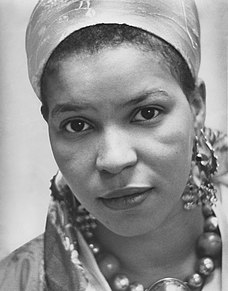
According to the University of American Poets, "many writers--Native Americans, Latinos/as, gays and lesbians, and younger generations of African Americans accept acknowledged their debt to the Black Arts Motility."[17] The movement lasted for nearly a decade, through the mid-1960s and into the 1970s. This was a flow of controversy and change in the world of literature. One major change came through in the portrayal of new ethnic voices in the The states. English-language literature, prior to the Black Arts Motility, was dominated by white authors.[36]
African Americans became a greater presence not only in the field of literature merely in all areas of the arts. Theater groups, poetry performances, music and dance were central to the movement. Through dissimilar forms of media, African Americans were able to educate others about the expression of cultural differences and viewpoints. In particular, blackness poetry readings allowed African Americans to use vernacular dialogues. This was shown in the Harlem Writers Society, which included black writers such as Maya Angelou and Rosa Guy. These performances were used to express political slogans and equally a tool for organization. Theater performances also were used to convey community issues and organizations. The theaters, equally well as cultural centers, were based throughout America and were used for community meetings, written report groups and film screenings. Newspapers were a major tool in spreading the Blackness Arts Movement. In 1964, Black Dialogue was published, making information technology the start major Arts movement publication.
The Blackness Arts Movement, although short, is essential to the history of the The states. It spurred political activism and use of speech throughout every African-American community. It immune African Americans the chance to express their voices in the mass media as well as become involved in communities.
It can be argued that "the Black Arts movement produced some of the most exciting poetry, drama, trip the light fantastic toe, music, visual art, and fiction of the mail service-World State of war Two United states of america" and that many important "postal service-Black artists" such every bit Toni Morrison, Ntozake Shange, Alice Walker, and August Wilson were shaped by the move.[fifteen]
The Black Arts Move also provided incentives for public funding of the arts and increased public support of various arts initiatives.[15]
Legacy [edit]
The movement has been seen as 1 of the most important times in African-American literature. Information technology inspired black people to establish their own publishing houses, magazines, journals and art institutions. It led to the creation of African-American Studies programs within universities.[37] The movement was triggered by the assassination of Malcolm X.[16] Amidst the well-known writers who were involved with the movement are Nikki Giovanni, Sonia Sanchez, Maya Angelou, Hoyt W. Fuller, and Rosa Guy.[38] [39] Although not strictly part of the Motility, other notable African-American writers such as novelists Toni Morrison and Ishmael Reed share some of its artistic and thematic concerns. Although Reed is neither a movement apologist nor advocate, he said:
I think what Black Arts did was inspire a whole lot of Blackness people to write. Moreover, there would exist no multiculturalism movement without Black Arts. Latinos, Asian Americans, and others all say they began writing as a event of the case of the 1960s. Blacks gave the example that yous don't have to assimilate. You could practise your ain thing, become into your own background, your own history, your own tradition and your own civilization. I remember the challenge is for cultural sovereignty and Blackness Arts struck a accident for that.[40]
BAM influenced the world of literature with the portrayal of dissimilar ethnic voices. Before the motility, the literary catechism lacked diversity, and the ability to express ideas from the bespeak of view of racial and ethnic minorities, which was not valued by the mainstream at the time.
Influence [edit]
Theater groups, verse performances, music and dance were centered on this movement, and therefore African Americans gained social and historical recognition in the expanse of literature and arts. Due to the bureau and credibility given, African Americans were as well able to educate others through different types of expressions and media outlets about cultural differences. The most mutual form of teaching was through poesy reading. African-American performances were used for their own political advertisement, system, and community issues. The Black Arts Movement was spread by the use of newspaper advertisements.[41] The first major arts movement publication was in 1964.
"No ane was more competent in [the] combination of the experimental and the vernacular than Amiri Baraka, whose volume Blackness Magic Poetry 1961–1967 (1969) is i of the finest products of the African-American creative energies of the 1960s."[17]
Notable individuals [edit]
- Amiri Baraka (formerly LeRoi Jones)
- Larry Neal
- Nikki Giovanni
- Maya Angelou
- Gwendolyn Brooks
- Haki R. Madhubuti (formerly Don Lee)
- Sun Ra
- Audre Lorde
- James Baldwin
- Hoyt W. Fuller
- Ishmael Reed
- Rosa Guy
- Dudley Randall
- Ed Bullins
- David Henderson
- Henry Dumas
- Sonia Sanchez
- Faith Ringgold
- Ming Smith
- Betye Saar
- Cheryl Clarke
- John Henrik Clarke
- Jayne Cortez
- Don Evans
- Mari Evans
- Sarah Webster Fabio
- Wanda Coleman
- Askia M. Touré
- Marvin X
- Ossie Davis
- June Jordan
- Sarah E. Wright
- Amina Baraka (formerly Sylvia Robinson)
- Ellis Haizlip
Notable organisations [edit]
- AfriCOBRA
- Black Academy of Arts and Letters
- Black Artists Group
- Black Arts Repertory Theatre Schoolhouse
- Black Dialogue
- Black Emergency Cultural Coalition
- Broadside Press
- Freedomways
- Harlem Writers Club
- Negro Digest
- Organization of Black American Culture
- Soul Volume
- Soul!
- The Black Scholar
- The Crusader
- The Liberator
- Uptown Writers Move
- Where We At
See also [edit]
- African-American art
- African American culture
- Africanfuturism
- Afrofuturism
- Black pride
- Négritude
- Progressive soul
References [edit]
- ^ a b c d e f g Foster, Hannah (2014-03-21). "The Black Arts Movement (1965-1975)". Black Past. Black Past. Retrieved 9 February 2019.
- ^ a b c d e f Salaam, Kaluma. "Historical Overviews of The Black Arts Movement". Department of English language, Academy of Illinois . Retrieved nine February 2019.
- ^ Finkelman, Paul, ed. (2009). Encyclopedia of African American History. Vol. 1. Oxford: Oxford University Press. p. 187. ISBN9780195167795.
- ^ a b c d Bracey, John H.; Sanchez, Sonia; Smethurst, James Edward, eds. (2014). SOS-Calling All Black People : a Blackness Arts Movement Reader. p. 7. ISBN9781625340306. OCLC 960887586.
- ^ Neal, Larry (Summertime 1968). "The Blackness Arts Movement". The Drama Review. 12 (four): 29–39. doi:10.2307/1144377. JSTOR 1144377.
- ^ Iton, Richard. In Search of the Blackness Fantastic: Politics and Popular Culture in the Post Civil Rights Era.
- ^ Woodard, Komozi (1999). A Nation within a Nation. Chapel Hill and London: The Academy Of North Carolina Printing. doi:10.5149/uncp/9780807847619. ISBN9780807847619.
- ^ Jeyifous, Abiodun (Winter 1974). "Blackness Critics on Black Theatre in America: An Introduction". The Drama Review. xviii (3): 34–45. doi:ten.2307/1144922. JSTOR 1144922.
- ^ Muhammad, Khalil Gibran (2010). The condemnation of blackness : race, crime, and the making of modern urban America (1st Harvard University Press paperback ed.). Cambridge, Mass.: Harvard University Press. pp. 1–xiv. ISBN9780674054325. OCLC 809539202.
- ^ Kuenz, Jane (2007). "Modernism, Mass Culture, and the Harlem Renaissance: The Case of Countee Cullen". Modernism/Modernity. 14 (3): 507–515. doi:10.1353/mod.2007.0064. S2CID 146484827.
- ^ a b Nash, William R. (2017). "Black Arts Movement". Oxford Research Encyclopedia of Literature. doi:10.1093/acrefore/9780190201098.013.630. ISBN978-0-19-020109-8.
- ^ Rae, Brianna (xix February 2016). "From the Harlem Renaissance to the Blackness Arts Move, Writers Who Changed the World". The Madison Times.
- ^ The Harlem renaissance. Encyclopaedia Britannica. 1999. OCLC 40923010.
- ^ Fortune, Angela Joy (2012). "Keeping the communal tradition of the Umbra Poets: creating space for writing". Black History Bulletin. 75 (one): 20–25. JSTOR 24759716. Gale A291497077.
- ^ a b c d e f g h i j Smethurst, James E. The Blackness Arts Motion: Nationalism in the 1960s and 1970s (The John Promise Franklin Series in African American History and Civilization), NC: The University of North Carolina Press, 2005.[ page needed ]
- ^ a b Salaam, Kalamu ya. "Historical Groundwork of the Black Arts Move (BAM) — Office 2". The Blackness Collegian. Archived from the original on Apr 20, 2000.
- ^ a b c "A Brief Guide to the Blackness Arts Motility". poets.org. February 19, 2014. Retrieved March six, 2016.
- ^ Douglas, Robert L. Resistance, Insurgence, and Identity: The Fine art of Mari Evans, Nelson Stevens, and the Black Arts Movement. NJ: Africa World Press, 2008.[ page needed ]
- ^ Bracey, John H. (2014). SOS- Calling All Black People: A Black Arts Movement Reader. Massachusetts: University of Massachusetts Press. p. eighteen. ISBN978-ane-62534-031-3.
- ^ "A Gathering of the Tribes" Archived 2016-04-xv at the Wayback Machine (Place Matters, January 2012) includes biography of Steve Cannon.
- ^ "Historical Overview of the Blackness Arts Motion". Department of English, University of Illinois at Urbana-Champaign.
- ^ a b c d Smith, David Lionel (1991). "The Black Arts Movement and Its Critics". American Literary History. 3 (1): 93–110. doi:ten.1093/alh/3.1.93.
- ^ a b Pollard, Cherise A. (2006). "Sexual Subversions, Political Inversions: Women's Verse and the Politics of the Black Arts Movement". In Collins, Lisa Gail; Crawford, Margo Natalie (eds.). New Thoughts on the Blackness Arts Movement. Rutgers University Press. pp. 173–186. ISBN9780813536941. JSTOR j.ctt5hj474.12.
- ^ Neal, Larry (1968). "The Blackness Arts Move". The Drama Review. 12 (4): 28–39. doi:10.2307/1144377. JSTOR 1144377.
- ^ Neal, Larry. "The Black Arts Move", Floyd W. Hayes III (ed.), A Turbulent Voyage: Readings in African American Studies, San Diego, California: Collegiate Printing, 2000 (3rd edition), pp. 236–246.
- ^ "Black Arts Motion". Encyclopædia Britannica article
- ^ a b Smalls, James (2001). "Black aesthetic in America". Grove Music Online (eighth ed.). Oxford Academy Press. doi:ten.1093/gmo/9781561592630.commodity.T2088343.
- ^ Duncan, John; Gayle, Addison (1972). "Review of The Black Artful, Addison Gayle, Jr". Journal of Research in Music Teaching. xx (1): 195–197. doi:ten.2307/3344341. JSTOR 3344341. S2CID 220628543.
- ^ Karenga, Ron (Maulana) (2014). "Blackness Cultural Nationalism". In Bracey, John H.; Sanchez, Sonia; Smethurst, James (eds.). SOS -- Calling All Blackness People: A Black Arts Movement Reader. University of Massachusetts Press. pp. 51–54. ISBN9781625340306. JSTOR j.ctt5vk2mr.ten.
- ^ Kuryla, Peter (2005), "Black Arts Movement", Encyclopedia of African American Society, SAGE Publications, Inc., doi:10.4135/9781412952507.n79, ISBN9780761927648
- ^ a b MacKey, Nathaniel (1978). "Ishmael Reed and the Blackness Aesthetic". CLA Journal. 21 (3): 355–366. JSTOR 44329383.
- ^ a b Ellis, Trey (1989). "The New Black Artful". Callaloo (38): 233–243. doi:10.2307/2931157. JSTOR 2931157.
- ^ a b Immature, Kevin, ed. (2020). Black Poem, African American Verse: 250 Years of Struggle & Song. Library of America. pp. 396–398. ISBN9781598536669.
- ^ a b c "Popular Music and the Spatialization of Race in the 1990s | The Gilder Lehrman Institute of American History". world wide web.gilderlehrman.org. July 12, 2012. Retrieved October 31, 2016.
- ^ "Amiri Baraka". Poetry Foundation. October 31, 2016. Retrieved October 31, 2016.
- ^ Nielson, Erik (2014). "White Surveillance of the Black Arts". African American Review. 47 (1): 161–177. doi:10.1353/afa.2014.0005. JSTOR 24589802. S2CID 141987673. Projection MUSE 561902.
- ^ Rojas, Fabio (2006). "Social Motility Tactics, Organizational Alter and the Spread of African-American Studies". Social Forces. 84 (iv): 2147–2166. doi:x.1353/sof.2006.0107. JSTOR 3844493. S2CID 145777569. Project MUSE 200998.
- ^ Cheryl Higashida, Black Internationalist Feminism: Women Writers of the Black Left, 1945-1995, University of Illinois Press, 2011, pp. 52–53.
- ^ Nelson, Emmanuel South., The Greenwood Encyclopedia of Multiethnic American Literature: A — C, Westport, CT: Greenwood Press, 2005, p. 387.
- ^ "The Black Arts Movement (BAM)". African American Literature Book Lodge . Retrieved March six, 2016.
- ^ "The Black Arts Movement (1965-1975)." The Black Arts Motion (1965-1975) | The Blackness Past: Remembered and Reclaimed, www.blackpast.org/aah/black-arts-motion-1965-1975.
External links [edit]
- Black Arts Repertory Theatre/School
- Black Arts Movement Page at University of Michigan
- Amazing Street arts, Black street Arts West: Culture and Struggle in Postwar Los Angeles
Source: https://en.wikipedia.org/wiki/Black_Arts_Movement
0 Response to "Leroi Jones Was Not a Significant Writer of the Black Arts Era True or False"
Post a Comment